Facts checked Article
Live-dealer casino UX
Best live casino: what happens on the stream, what happens in the round, and the timings the published rules set
The best live casino, by this site’s test, is the one whose operator publishes what happens in the round when the stream fails. Two systems, the standards that govern each, one published decision window, and a stream-delay column marked Not tested until we measure it.
What is a live casino?
The best live casino, by the only test this site applies, is the one whose operator publishes what happens in the round when the stream fails, and whose timings you can check against the published rules. We rank nobody.
A live casino is two systems: a video stream of a studio table that you watch, and a game server that records bets, outcomes and settlement. The second one pays.
The Gambling Commission’s technical standards do not define ‘live casino’ (RTS 2 has no entry for it, read 21 September 2026). They regulate its parts instead. RTS 17A requires that ‘live dealer operations must be fair and independently auditable’.
RTS 10 covers what happens when a connection breaks. RTS 4 covers games where speed of interaction matters. Each is quoted below with the date read.
This page publishes its method before any figure, and where we have not measured something it says ‘Not tested’. In this edition the stream-delay column is Not tested throughout: the assignment allowed page fetches only, not a browser session at a table. The published timings are set out; ours are not, yet.
The standards that apply to a live table
- Fairness and audit
- RTS 17A: ‘Live dealer operations must be fair and independently auditable.’ Guidance: video surveillance ‘to record all dealer activity’ and game logs ‘collated into statistics’.Remote gambling and software technical standards (RTS) – RTS 17 – Live dealer studios · as checked on
- Interrupted round
- RTS 10A guidance: where an interruption occurs after the operator receives notification of the gamble, ‘the results of the gamble should stand’.Remote gambling and software technical standards (RTS) – RTS 10 – Interrupted gambling · as checked on
- Latency
- RTS 4A guidance lists ‘estimating the degree of network latency (delay) a customer is experiencing and displaying regularly updated information’ as one possible approach where speed affects the chance of winning.Remote gambling and software technical standards (RTS) – RTS 4 – Time-critical events · as checked on
- Session clock
- RTS 13C: ‘The elapsed time should be displayed for the duration of the gaming session.’Remote gambling and software technical standards (RTS) – RTS 13 – Time requirements and reality checks · as checked on
- Published decision time on one named product
- Speed Blackjack (Evolution): ‘Reduced decision time (7 seconds)’, as listed in BlackjackInfo’s game specifications. Not the provider’s own page; not measured by us.Speed Blackjack by Evolution Gaming Review (Full Game Specifications) · as checked on
How does a live casino round relate to the stream on your screen?
The stream — what arrives on your screen and when. The picture you watch is encoded in the studio, sent across the network and decoded on your device. Every stage adds delay.
The round, meanwhile, runs on the game server’s clock: bets open, bets close, the outcome is recorded, the settlement is posted to your account.
The gap between the two is the measurement this site exists to make. Method, for when we make it: a reference clock in shot or on a second device, the on-screen timer at the table, five rounds per table. Delay is recorded as the difference between the server-driven timer event and its appearance on screen.
Readout format: Stream delay: n s (measured, method §2). Status today: Not tested.
The standards recognise the gap without naming it. RTS 4A applies ‘where speed of interaction has a significant effect on the customer’s chance of winning’ (read 21 September 2026). Its guidance suggests ‘estimating the degree of network latency (delay) a customer is experiencing’.
It also suggests telling the customer about ‘any disadvantage that they may be operating under (for example high, medium, low)’. Whether a given table shows such an indicator is an observation we have not yet recorded.
The method — how stream delay will be measured
Published before any figure, as this site’s order requires. Status today: Not tested.
Put a reference clock in shot
A reference clock in shot, or on a second device, gives a time the stream cannot alter.
Watch the on-screen timer
The table’s decision timer is driven by the game server, so each timer event marks the server’s clock.
Time five rounds per table
Delay is recorded as the difference between the server-driven timer event and its appearance on screen, five rounds per table.
What the result means
The readout format is Stream delay: n s (measured, method §2). The column stays Not tested until a browser session at each table has been run.
Terms used on this page
- Decision window
- The seconds the game server allows for a bet or decision, counted on its own clock, not from what you see.
- Latency
- The delay between an event at the table and its appearance on your screen; every encoding and network stage adds some.
- Round record
- The game server’s log of bets, outcomes and settlement for a round; the record that pays.
- Settlement
- The point at which the server posts a round’s result to your account.
- Progressive jackpot
- A prize pool that grows from stakes; RTS 10A guidance says its value should be restored to its pre-failure state after an interruption.
What companies offer the best live casino streaming services in the UK?
We do not rank operators or studios. What can be compared is what each publishes: the decision window, the interruption policy, and the audit arrangements. RTS 10C requires operators to disclose ‘information about their policies regarding service interruptions in various different circumstances’ (read 21 September 2026), so a help page with no interruption policy is itself a finding.
We tried to read two operators’ pages for this edition. The bet365 game-disconnections help page and the Paddy Power terms page both returned HTTP 403 to a plain fetch on 21 September 2026, so neither is quoted. Status: Not re-checked since the last edition that could open them.
A reader with an account can open them directly and compare the wording against RTS 10A.
The one published timing we could read came from a third-party specification page, not from a provider: BlackjackInfo lists Speed Blackjack (Evolution) with ‘Reduced decision time (7 seconds)’ and a studio in Riga, Latvia (read 21 September 2026). It is a reference figure, recorded as such in the table, not a measurement.
Which software developers create the best live casino platforms?
Again, no ranking. The developer whose pages we read for this edition is Evolution, whose brands page lists Evolution, NetEnt, Red Tiger, Ezugi, Big Time Gaming, Nolimit City, Sneaky Slots and DigiWheel (read 21 September 2026). The page says nothing about stream latency, decision windows or disconnection handling.
A developer page tells you which studios exist; it does not tell you the delay between the studio and your screen. That figure has to be measured at a table, and it varies with your own connection.
What a developer or operator can publish, and what RTS 17A guidance expects, is the audit trail: commercial-quality equipment, trained croupiers, surveillance covering the gaming areas, access controls and game logs. Those are the lines to look for on a studio’s own page, and they were not on the brands page we read.
Audit-trail lines to look for on a studio’s own page
What RTS 17A guidance expects a developer or operator to be able to publish. None of these lines was on the Evolution brands page we read on 21 September 2026.
Ticks are kept only in this browser and are never sent anywhere.
Are there regulatory bodies overseeing live casino fairness in the UK?
Yes: the Gambling Commission, through the licence conditions and the remote technical standards. RTS 17A states the requirement in nine words: ‘Live dealer operations must be fair and independently auditable’ (read 21 September 2026). The guidance beneath it is specific about the means.
Surveillance: ‘video surveillance to record all dealer activity should be in place, enough to cover the predefined gaming areas with sufficient detail to confirm whether dealing procedures and game rules were followed’. Records: ‘game logs should be maintained and game events collated into statistics which can be analysed for trends’. Equipment: ‘of commercial casino quality’.
Access: secure areas and consumables ‘protected by appropriate access controls’.
Where a live product uses a random number generator for any part of the outcome, RTS 7A applies as well (read 21 September 2026). Results must be ‘acceptably random’. Under 7B they must be implemented ‘in accordance with the rules and prevailing payouts … as they are described to the customer’.
The standard does not name the auditor on that page; it requires the operation to be auditable. Neither the standard nor the pages we read publishes a per-table audit report for readers, and we have not seen one.
RTS 17A guidance, line by line
- Surveillance
- ‘Video surveillance to record all dealer activity should be in place, enough to cover the predefined gaming areas with sufficient detail to confirm whether dealing procedures and game rules were followed.’Remote gambling and software technical standards (RTS) – RTS 17 – Live dealer studios · as checked on
- Records
- ‘Game logs should be maintained and game events collated into statistics which can be analysed for trends.’Remote gambling and software technical standards (RTS) – RTS 17 – Live dealer studios · as checked on
- Equipment
- Equipment ‘of commercial casino quality’.Remote gambling and software technical standards (RTS) – RTS 17 – Live dealer studios · as checked on
- Access
- Secure areas and consumables ‘protected by appropriate access controls’.Remote gambling and software technical standards (RTS) – RTS 17 – Live dealer studios · as checked on
The means the guidance is specific about, quoted from the standard read 21 September 2026.
Are UK-licensed live casino operators guaranteed to be legitimate?
A licence means the standards above apply and the Commission can act when they are breached. It is not a promise about any single round, stream or session. Checking that a licence exists and covers the domain you are on is Licence Lens’s territory; this page assumes that check has been done.
What the licence does give you is a set of published obligations you can hold the operator to. RTS 10A requires interruption policies that ‘are fair and do not systematically disadvantage customers’. RTS 10C requires those policies to be disclosed.
RTS 13B requires a reality-check facility that shows ‘the time elapsed since the session began’, which the customer ‘must acknowledge … for it to be removed from the screen’ (read 21 September 2026).
If a help page you can open does not state its interruption policy, that is the first line to ask the operator about, and the disclosure requirement is the clause to cite.
Do online reviews confirm if live casinos operate honestly?
No. A review records one person’s experience of the stream, and the stream is not where the result lives. The record that can be checked is the round history on the game server, and the process that can be audited is the one RTS 17A guidance describes: surveillance, logs and statistics (read 21 September 2026).
A reader can do two things a review cannot. First, compare what the help page states about interruptions with RTS 10A guidance. Results stand once the bet is received.
Stakes are returned for single-stage events interrupted before the outcome is generated. Multi-stage games are restored ‘to their last known state’. Second, after any disputed round, open the round record and compare it with what the stream showed.
Our earlier note on reconstructing a round from the history covers that comparison.
A review that reports ‘the stream froze and I lost’ is reporting the first system. The question is what the second system recorded, and that is answered by the record, not the comment.
After a disputed round — the two checks a review cannot make
The comparison the prose above describes, in order. The stream is the first system; the round record is the second, and the second one pays.
Open the operator’s help page
Find what it states about interruptions. RTS 10C requires the policy to be disclosed, so a help page with no interruption policy is itself a finding.
Compare it with RTS 10A guidance
Results stand once the bet is received. Stakes are returned for single-stage events interrupted before the outcome is generated. Multi-stage games are restored to their last known state.
Open the round record
After any disputed round, open the round history on the game server and compare it with what the stream showed.
What the result means
The record answers what the second system did. A frozen stream is a report on the first system only; the rules and the record settle the hand.
Disconnection — what the standards say happens to your bet
RTS 10A guidance, read 21 September 2026, sets three cases. Where the interruption occurs after the operator has received notification of the gamble, ‘the results of the gamble should stand’. Where a single-stage event is interrupted before the outcome is generated, ‘the customer should have any deducted stake returned’.
Where a multi-stage game is interrupted, ‘all reasonable steps should be taken to restore the game to its last known state to enable the customer to complete the game’.
The same 10A guidance states that ‘progressive jackpot values should be restored to their pre-failure state’, and that games with multiple participants, which live tables are, ‘should be dealt with fairly on a case-by-case basis’. RTS 10B adds that systems must be capable of recovering from failures, including voiding gambles and restoring the amount gambled.
That last line is why the operator’s own published policy matters: the standard sets the principle and leaves the table-level rule to the operator.
A dropped hand is settled by the rules, not by the stream, and re-betting to ‘make it back’ is a separate decision. If it is becoming the usual one, GamCare’s helpline is 0808 8020 133.
Disconnection — the three cases RTS 10A guidance sets
- Interruption after the operator has received the gamble
- ‘The results of the gamble should stand.’Remote gambling and software technical standards (RTS) – RTS 10 – Interrupted gambling · as checked on
- Single-stage event interrupted before the outcome
- ‘The customer should have any deducted stake returned.’Remote gambling and software technical standards (RTS) – RTS 10 – Interrupted gambling · as checked on
- Multi-stage game interrupted
- ‘All reasonable steps should be taken to restore the game to its last known state to enable the customer to complete the game.’Remote gambling and software technical standards (RTS) – RTS 10 – Interrupted gambling · as checked on
The same guidance says progressive jackpot values should be restored to their pre-failure state and multi-participant games dealt with fairly case by case; RTS 10B requires systems able to recover, including voiding gambles and restoring the amount gambled.
The table: timed measurement of stream delay versus decision window across named live products, with method published
The method is published above; the measurements are not yet made. The table therefore records what is published for each system we could read and marks our own column Not tested; the two operator pages that returned 403 are listed in the closing section, not in the table.
It will be re-issued with readouts when a browser session at each table has been run under the method in the stream section.
| System or product | Decision window (s) | What happens on interruption | Stream delay (ours) (s) | Status | Evidence |
|---|---|---|---|---|---|
| Speed Blackjack (Evolution), per BlackjackInfo specification | 7 | Not stated on the specification page | Not tested | Reference figure, not provider page; not measured | · Speed Blackjack by Evolution Gaming Review (Full Game Specifications) |
| Any GB-licensed live table: RTS 10A guidance | Not stated | Results stand once the gamble is received; stake returned if a single-stage event is interrupted before the outcome; multi-stage games restored to last known state | Not tested | Standard read 21 September 2026 | · Remote gambling and software technical standards (RTS) – RTS 10 – Interrupted gambling |
| Any GB-licensed live table: RTS 4A guidance | Not stated | Not applicable; covers latency display where speed affects the chance of winning | Not tested | Standard read 21 September 2026 | · Remote gambling and software technical standards (RTS) – RTS 4 – Time-critical events |
| Evolution studios (brands page) | Not stated | Not stated | Not tested | Developer page lists studios, publishes no timings | · Brands | Live Casino, Slots, and RNG Portfolio |
A worked example in pounds
Take a £10 bet on a table whose decision window is 7 seconds, the one published figure we have. The server starts the 7-second clock when it opens the decision. If the stream reaches you 3 seconds late, you see the clock start 3 seconds after it did, and the time you actually have to act is 4 seconds.
At 5 seconds of delay it is 2 seconds. Nothing about the £10 changes; the outcome is settled server-side either way.
Now drop the connection. If the operator had already received your £10 bet, RTS 10A guidance says the result stands, win or lose, and you read it in the round record. If a single-stage event was interrupted before the outcome was generated, the £10 should be returned.
The stream is not consulted in either case.
The delay figures in this example are illustrations of the arithmetic, not measurements. The calculator below does the subtraction for whatever delay you observe yourself.
Time you actually have to act, and the stake at risk
Enter the published decision window, the stream delay you observe by the method in the stream section, and your stake. The output is time and cost only: the seconds left on screen after the delay, and the amount at risk in the round. No prize figure is shown.
Worked example: with published decision window 7 s, observed stream delay 3.0 s, stake in the round £10.00, seconds left on screen once the timer appears is 4.0 s and stake at risk if the result stands is £10.00. 7 s window minus 3 s delay leaves 4 s on screen; a £10 bet stays £10 at risk whether or not the stream keeps up.
Formula and figures: Remote gambling and software technical standards (RTS) – RTS 4 – Time-critical events
What we could not measure
Stream delay on any named table: Not tested in this edition, because the assignment allowed page fetches only. Decision windows on any table other than the one third-party specification: Not stated on the pages we could read. Operator interruption policies at bet365 and Paddy Power: Not read, both pages returned 403 to a plain fetch on 21 September 2026.
Whether any table displays the latency indicator RTS 4A guidance suggests: Not observed. Whether the round record and the stream ever disagreed on a table we watched: Not observed, because we watched none for this edition.
How the games on those tables are played is outside this site altogether; Wheel Theory, Twenty-One Notes and Baccarat Brief own the rules. Choosing not to sit at a live table is a valid response to every line above.
Questions answered
Six questions in the wording readers use, each answered in one sentence first and then from the standards.
Questions answered
How can I join a live casino game through popular online platforms?
This page does not walk anyone to a table; it describes the two systems behind one. Any GB-licensed operator offering live tables must meet RTS 17 on studio fairness and RTS 10 on interruptions, and the way to reach a table is described on that operator’s own help pages.
Source: Remote gambling and software technical standards (RTS) – RTS 17 – Live dealer studios
How can I verify if a live casino platform is trustworthy?
Check the licence on the Gambling Commission’s public register first (Licence Lens covers the procedure), then read the operator’s interruption policy, which RTS 10C requires it to disclose, against RTS 10A guidance. Trust is not a measurement; the published policy and the round record are.
Source: Remote gambling and software technical standards (RTS) – RTS 10 – Interrupted gambling
How do I find reputable live casino sites in the UK?
Reputation is not something this site scores; a GB licence, an interruption policy you can read, and a round history you can open are the three things the standards make checkable. Start with the register, not with a ranking.
Source: Remote gambling and software technical standards (RTS) – RTS 10 – Interrupted gambling
How do reputable live casino services ensure game integrity?
RTS 17A requires live dealer operations to be fair and independently auditable, with surveillance covering the gaming areas, access controls and game logs collated into statistics. Where an RNG is involved, RTS 7A requires results to be acceptably random.
Source: Remote gambling and software technical standards (RTS) – RTS 17 – Live dealer studios
How does a live casino platform operate behind the scenes?
Two systems: a studio stream you watch and a game server that records bets, outcomes and settlement. The server’s record is the one that pays, and the stream reaches you after a delay this site measures by a published method, Not tested in this edition.
Source: Remote gambling and software technical standards (RTS) – RTS 4 – Time-critical events
how does live casino work
A studio table is filmed and streamed; your bets go to the game server, which records the outcome and settles the round on its own clock. If the connection drops after the server has received your bet, RTS 10A guidance says the result stands.
Source: Remote gambling and software technical standards (RTS) – RTS 10 – Interrupted gambling
Sources checked 21 September 2026
Sources checked 21 September 2026. Gambling Commission, RTS 10 – Interrupted gambling (retrieved 21 September 2026). Gambling Commission, RTS 4 – Time-critical events (retrieved 21 September 2026).
Gambling Commission, RTS 13 – Time requirements and reality checks (retrieved 21 September 2026). Gambling Commission, RTS 17 – Live dealer studios (retrieved 21 September 2026). Gambling Commission, RTS 7 – Generation of random outcomes (retrieved 21 September 2026).
Evolution, Brands page (retrieved 21 September 2026). BlackjackInfo.com, Speed Blackjack by Evolution Gaming review, Full Game Specifications (retrieved 21 September 2026; third-party reference, not a provider page). Not read: bet365 game disconnections help page and Paddy Power terms and conditions, both HTTP 403 on 21 September 2026.
Questions answered
How can I join a live casino game through popular online platforms?
This page does not walk anyone to a table; it describes the two systems behind one. Any GB-licensed operator offering live tables must meet RTS 17 on studio fairness and RTS 10 on interruptions, and the way to reach a table is described on that operator’s own help pages.
How can I verify if a live casino platform is trustworthy?
Check the licence on the Gambling Commission’s public register first (Licence Lens covers the procedure), then read the operator’s interruption policy, which RTS 10C requires it to disclose, against RTS 10A guidance. Trust is not a measurement; the published policy and the round record are.
How do I find reputable live casino sites in the UK?
Reputation is not something this site scores; a GB licence, an interruption policy you can read, and a round history you can open are the three things the standards make checkable. Start with the register, not with a ranking.
How do reputable live casino services ensure game integrity?
RTS 17A requires live dealer operations to be fair and independently auditable, with surveillance covering the gaming areas, access controls and game logs collated into statistics. Where an RNG is involved, RTS 7A requires results to be acceptably random.
How does a live casino platform operate behind the scenes?
Two systems: a studio stream you watch and a game server that records bets, outcomes and settlement. The server’s record is the one that pays, and the stream reaches you after a delay this site measures by a published method, Not tested in this edition.
how does live casino work
A studio table is filmed and streamed; your bets go to the game server, which records the outcome and settles the round on its own clock. If the connection drops after the server has received your bet, RTS 10A guidance says the result stands.
Source material
- Remote gambling and software technical standards (RTS) – RTS 10 – Interrupted gambling
- Remote gambling and software technical standards (RTS) – RTS 4 – Time-critical events
- Remote gambling and software technical standards (RTS) – RTS 13 – Time requirements and reality checks
- Remote gambling and software technical standards (RTS) – RTS 17 – Live dealer studios
- Remote gambling and software technical standards (RTS) – RTS 7 – Generation of random outcomes
- Brands | Live Casino, Slots, and RNG Portfolio
- Speed Blackjack by Evolution Gaming Review (Full Game Specifications)
Continue reading
The three layers of a live-table screen
A live-table interface combines a video feed, interactive controls, and an account record.
Read The three layers of a live-table screen
Why is my online casino not working? What happens on the stream, and what happens in the round
When a live casino stream freezes, the picture has stopped but the round has not. What RTS 10 says happens to your bet, where RTS 1 says you can check it, and the five lines to write down.
Read Why is my online casino not working? What happens on the stream, and what happens in the round
Reconstruct a live-casino round from the history, not the replay
Match round identifiers, stakes and gross returns before interpreting a live-casino balance. A fictional ledger shows what records can and cannot establish.
Read Reconstruct a live-casino round from the history, not the replay
What a live-dealer studio audit can establish
Distinguish RTS 17 studio coverage from security and games-testing audits. Read a real disclosure response and keep unseen inspection findings unknown.
Read What a live-dealer studio audit can establish
What actually happens when your live casino timer runs out
A decision timer expiring and a connection dropping are governed by different rules with different default actions. Read against UK Gambling Commission standards, a US regulator's published default and one UK operator's own disconnection wording.
Read What actually happens when your live casino timer runs out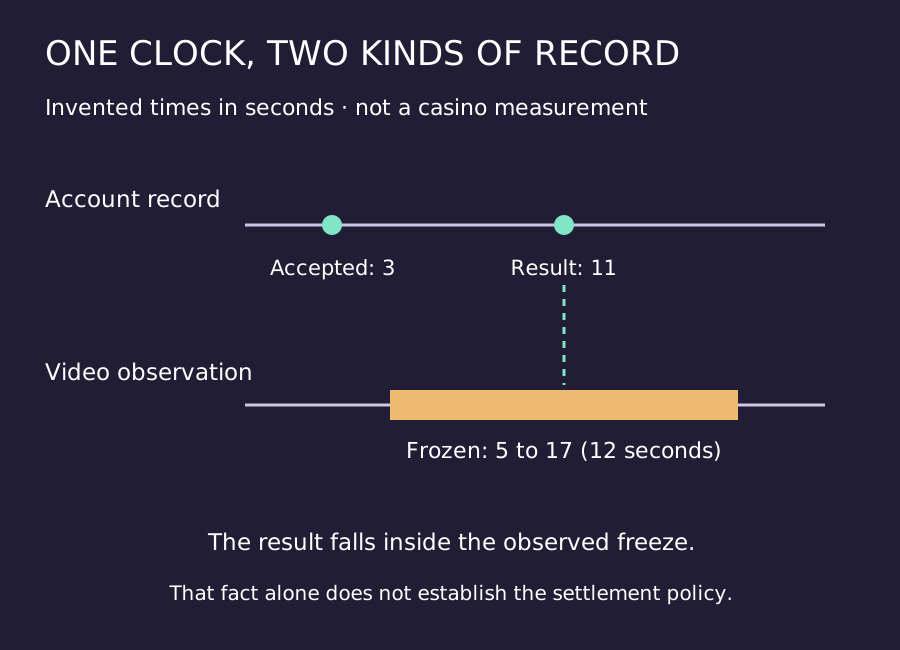
How does a live casino round relate to the stream on your screen?
Follow a live round through acceptance, video, decisions and account records, with an original timeline exercise and a Crazy Time product example.
Read How does a live casino round relate to the stream on your screen?
Continue reading
Reconstruct a live-casino round from the history, not the replay
Match round identifiers, stakes and gross returns before interpreting a live-casino balance. A fictional ledger shows what records can and cannot establish.
Read Reconstruct a live-casino round from the history, not the replayWhat a live-dealer studio audit can establish
Distinguish RTS 17 studio coverage from security and games-testing audits. Read a real disclosure response and keep unseen inspection findings unknown.
Read What a live-dealer studio audit can establishThe three layers of a live-table screen
A live-table interface combines a video feed, interactive controls, and an account record.
Read The three layers of a live-table screenInspect a live-table interface
The three layers of a live-table screen
Why is my online casino not working? What happens on the stream, and what happens in the round
What actually happens when your live casino timer runs out
Reconstruct a live-casino round from the history, not the replay
How does a live casino round relate to the stream on your screen?