Facts checked Article
Live-dealer casino UX
Reconstruct a live-casino round from the history, not the replay
Match round identifiers, stakes and gross returns before interpreting a live-casino balance. A fictional ledger shows what records can and cannot establish.
Start with the round you are trying to identify
A live-dealer picture and an account entry answer different questions. The picture shows what reached the screen; the account entry records financial activity attributed to the customer. To investigate an unclear completed round, match the game and round reference to its accepted stake, result and return.
A replay without that match cannot establish the customer's settlement.
This is a method for reading records after a streaming problem, not a measured test of network delay. No live account, private history or studio log was accessed. The worked record below is invented and labelled as such.
It gives a reader a repeatable way to identify what is known and what still needs an operator's explanation.
Great Britain's Gambling Commission addresses customer history in RTS 1, transaction information in RTS 2 and interrupted gambling in RTS 10. These are distinct requirements. Their existence does not prove that an individual transaction was correct, nor does it give a customer access to every internal server event.
Sources: RTS 1 – Customer account information; RTS 2 – Displaying transactions; RTS 10 – Interrupted gambling.
The round record — what it can and cannot establish
- Two records, two questions
- A live-dealer picture shows what reached the screen; an account entry records financial activity attributed to the customer.RTS 2 – Displaying transactions · as checked on
- The match to make
- Match the game and round reference to its accepted stake, result and return. A replay without that match cannot establish the customer's settlement.RTS 2 – Displaying transactions · as checked on
- Three distinct requirements
- The Gambling Commission addresses customer history in RTS 1, transaction information in RTS 2 and interrupted gambling in RTS 10.RTS 1 – Customer account information · as checked on
- What they do not prove
- Their existence does not prove that an individual transaction was correct, nor does it give a customer access to every internal server event.RTS 10 – Interrupted gambling · as checked on
- Status of this note
- A method for reading records after a streaming problem, not a measured test of network delay.RTS 1 – Customer account information · as checked on
Method before result. The worked record below is invented and labelled as such; no live account, private history or studio log was accessed.
Know what the published history requirement promises
RTS 1B requires easy access to at least three months of account and gambling history without contacting the licensee, and at least twelve months on request. Its gaming guidance allows full or summarised information and distinguishes details of the last game from summaries of earlier activity.
It should not be paraphrased as a promise that every old live round has a customer-visible video replay.
That limit matters when a statement contains a total for a session rather than each decision. A summary can help reconcile money without showing why a particular action was accepted or rejected. Conversely, a detailed round view may explain one game while omitting unrelated transfers that affected the overall balance.
Before comparing two screens, record their scope. Is one showing the latest hand, a session, a calendar day or an account period? Note the currency, time zone and filter if displayed.
If a field is not supplied, mark it absent. A worksheet with a visible gap is more reliable than one completed with a guessed timestamp or a familiar interpretation of an unlabeled total.
Sources: RTS 1 – Customer account information.
Build a record with enough identifiers to match
Start a private note with the operator, provider and exact table or game name, to the extent those are visible. Add the date, approximate local time with time zone, and any round or transaction reference the interface supplies. Do not invent a reference because the support form appears to expect one.
An explicitly missing identifier is useful information.
Keep three observations separate: the action attempted, any acceptance message actually seen, and the later history entry. A click is evidence of an attempted action. An acceptance message adds information, but its absence during a frozen stream does not by itself prove acceptance or rejection.
The history and operator's records are needed to connect that attempt to a settlement.
Describe a frozen picture literally. For example, write that the image stopped updating while a round reference remained visible, if that is what happened. Do not translate that into the server stopped, the dealer stopped or the bet was cancelled.
Those conclusions require evidence from another part of the system. Precise observation keeps a record useful without claiming technical access the reader does not have.
Sources: RTS 2 – Displaying transactions.
The private note — identifiers and observations to record
Do not invent a reference because the support form appears to expect one; an explicitly missing identifier is useful information. Do not translate a frozen picture into the server stopped, the dealer stopped or the bet was cancelled.
Ticks are kept only in this browser and are never sent anywhere.
A fictional ledger with a real reconciliation method
The following is a constructed example in pounds. It assumes the history reports gross returns separately from stakes, and that there are no deposits, withdrawals, transfers or other rounds within the interval. R-A, R-B and R-C are invented references.
No game's payout rules are being inferred from them.
The total stake is £14 and total gross return is £14. Closing balance is therefore £50 + £14 − £14 = £50. The £8 credit on R-A does not mean £8 profit; that round's stake was £4.
R-C has a credit without a net gain.
If the stream froze during R-B, the ledger would still show a £4 deduction and no return for that reference. That establishes what this fictional record contains. It does not establish that the deduction was correctly settled, what action was available, or why the stream froze.
Those are separate questions for the exact round evidence.
| Record | Stake deducted | Gross return credited | Net movement | Running balance |
|---|---|---|---|---|
| Opening balance | — | — | — | £50 |
| R-A | £4 | £8 | +£4 | £54 |
| R-B | £4 | £0 | −£4 | £50 |
| R-C | £6 | £6 | £0 | £50 |
Reconcile the right quantity before alleging a mismatch
An account balance, session net position and gross return are different quantities. RTS 2E concerns the session's net position; the fictional table instead displays both individual movements and a running balance. The arithmetic is consistent only because the example explicitly excludes other movement.
A real balance comparison may need those additional entries.
Take a further fictional variation: the final account balance reads £55 instead of £50, and a separate £5 transfer into the product appears in the same interval. Including that transfer reconciles the balance; treating the extra £5 as round profit would not. This does not imply transfers are always the explanation.
It shows why the scope of the record must be settled first.
Similarly, determine whether a field named return includes the stake, and whether winnings is a profit field or a gross credit. Do not subtract stakes twice. Where labels are unclear, preserve the label exactly in the private note and ask for its definition.
A discrepancy stated as opening balance plus credits minus debits differs from closing balance by a specified amount is more precise than a general claim that a displayed win went missing.
Sources: RTS 2 – Displaying transactions.
How to reconcile a round history against the balance
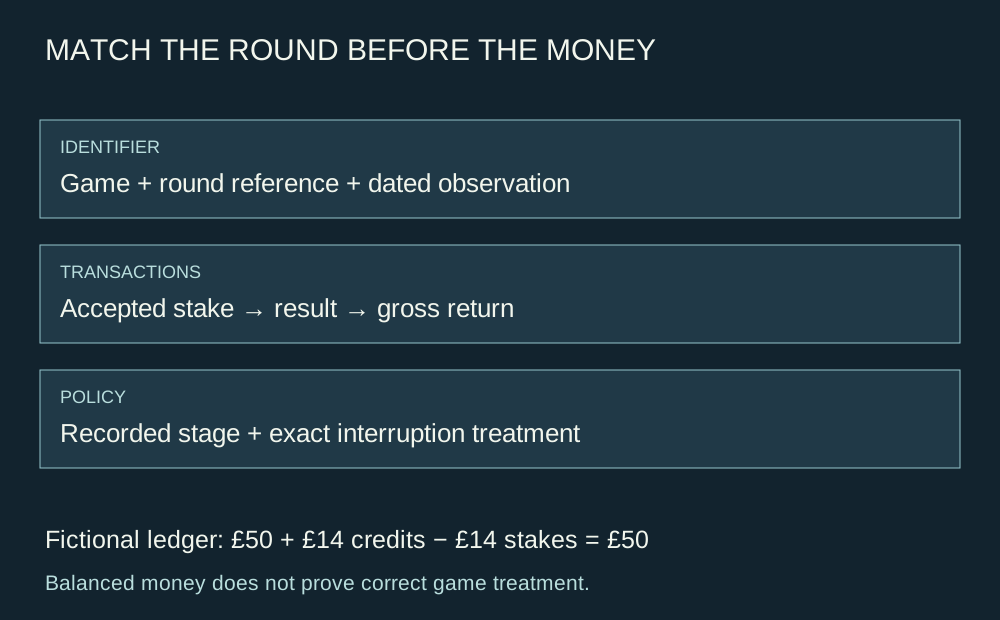
The fictional ledger's arithmetic holds only because the example excludes other movement: £50 + £14 − £14 = £50.
Fix the scope of each screen
Record whether it shows the latest hand, a session, a calendar day or an account period, with the currency, time zone and filter if displayed.
Match the round reference
Connect the round reference to its accepted stake, result and gross return before reading anything else.
Define each field
Determine whether a field named return includes the stake, and whether winnings is a profit field or a gross credit. Do not subtract stakes twice.
Add the movements
Opening balance plus credits minus debits is compared with the closing balance for the interval.
Include other movement in the interval
A deposit, withdrawal or transfer changes the closing balance. In the fictional variation, a separate £5 transfer explains a balance of £55 instead of £50; treating it as round profit would not.
What the result means
Either the entries reconcile to the closing balance or they differ by a specified amount. A balanced ledger does not prove every game action was correct or that the interruption rule was applied.
Read interruption policy against the recorded stage
RTS 10 distinguishes several interruption circumstances. Its guidance says an accepted gamble can stand when the customer has no further influence on the outcome; it also addresses pre-outcome interruption of a single-participant single-stage event and restoration of stateful games. Those distinctions prevent a blanket conclusion that loss of video means a refund.
Use the record to identify the unresolved stage, not to choose the most favourable branch automatically. If acceptance is uncertain, ask whether the gamble was received. If a further decision was due, ask which state was retained and what the game's interruption policy specified.
If settlement exists, request the result and the basis for applying that policy to the identified round.
This article does not reproduce blackjack, roulette or baccarat rules. It also does not assign a default action to every live table. A public help article may combine several products in a short answer; a specific round still needs its own game and policy.
The recorded observation and the applicable rule should meet at the same reference, rather than being connected solely because both mention a disconnection.
Sources: RTS 10 – Interrupted gambling.
Interruption — the question for each recorded stage
RTS 10 guidance says an accepted gamble can stand when the customer has no further influence on the outcome; loss of video does not by itself mean a refund. Use the record to identify the unresolved stage, not to choose the most favourable branch automatically.
Ticks are kept only in this browser and are never sent anywhere.
Make a support question that can be answered
A useful request could say: please confirm the accepted stake, recorded result, gross return and interruption treatment for the identified round; the picture froze at the approximate time recorded in my note. This is a suggested question, not a message sent during our research. It names the missing fields without claiming a diagnosis of the provider's systems.
Keep the relevant record private. There is no need to publish a full account statement to explain a single round. If preparing an excerpt for a public discussion, remove personal details and unrelated financial entries.
Retain the original privately so that editing the excerpt does not become the only surviving record.
Distinguish a support answer from independent verification. An operator explanation is evidence of its stated treatment. It may resolve the arithmetic, leave a rule question open or identify a correction; those are different outcomes.
The worksheet has space for each rather than a single fixed verdict. This note makes no claim about response times, refunds, compensation or the result of a complaint. None of those was tested.
Sources: RTS 1 – Customer account information; RTS 10 – Interrupted gambling.
State the conclusion at the level the evidence permits
The most useful conclusion can be modest: these entries reconcile to the closing balance, but the interruption rule for this round remains unexplained. Another could be that the public summary lacks the individual record required to resolve the issue. Neither finding establishes fraud, an audit failure or a measured latency figure.
The original diagram beside this article connects identifiers, transactions and policy through a single round record. Its arrows describe a reading method, not a measured data path or timing diagram. A screenshot of the video may help describe what was visible, but it cannot replace the accepted-stake record.
Equally, a balanced ledger does not prove every game action was correct.
The documentary sources were checked on 19 September 2026. No live incident was manufactured, no wager was made and no private account information was collected. The exercise can be completed after stopping play.
Further gambling is not a useful way to recreate a missing record or establish what happened in an earlier round. Gambling can cause harm.
Terms used in this note
- RTS
- The Gambling Commission's remote gambling and software technical standards; RTS 1, RTS 2 and RTS 10 are the ones cited here.
- Round reference
- The identifier the interface supplies for one round; the field that lets a stake, result and return be matched to it.
- Gross return
- The amount credited for a round including any returned stake; not the same as profit.
- Net movement
- The gross return credited minus the stake deducted for the same round.
- Running balance
- The account balance after each entry, as the fictional ledger shows it.
- Session net position
- The quantity RTS 2E concerns; a different quantity from an account balance and from a gross return.
- Settlement
- The financial outcome recorded for an accepted stake once the result is known.
Questions answered
How does a live casino round relate to the stream on your screen?
The stream shows a view of events; an accepted-stake and settlement record concerns the customer’s participation. Match the round reference before using one to explain the other.
What happens if the stream stops?
A stopped picture alone does not establish that a bet was voided. Preserve any visible reference and check the round history and the exact game’s interruption policy.
What happens to my bets if I am disconnected?
Treatment depends on the recorded stage and applicable policy. RTS 10 distinguishes accepted gambles with no further customer influence from other interruption circumstances; this article does not assign one default to every live game.
What is a live casino?
For this note it means online participation in games presented from a live-dealer setting. The subject is how a completed round is represented in records, not a claim that a camera view proves an individual settlement correct.
How far back must a live-casino round history go?
RTS 1B requires easy access to at least three months of account and gambling history without contacting the licensee, and at least twelve months on request. Summarised information is allowed, so it is not a promise that every old live round has a customer-visible video replay.
Does a credit in the history mean the round made a profit?
Not on its own. In the fictional ledger the £8 credit on R-A does not mean £8 profit, because that round's stake was £4; R-C has a credit without a net gain.
Does a balanced ledger prove the round was settled correctly?
No. Reconciling the entries to the closing balance establishes what the record contains; it does not establish that a deduction was correctly settled, what action was available or why the stream froze.
Source material
Continue reading
The three layers of a live-table screen
A live-table interface combines a video feed, interactive controls, and an account record.
Read The three layers of a live-table screen
Why is my online casino not working? What happens on the stream, and what happens in the round
When a live casino stream freezes, the picture has stopped but the round has not. What RTS 10 says happens to your bet, where RTS 1 says you can check it, and the five lines to write down.
Read Why is my online casino not working? What happens on the stream, and what happens in the round
Best live casino: what happens on the stream, what happens in the round, and the timings the published rules set
The best live casino, by this site’s test, is the one whose operator publishes what happens in the round when the stream fails. Two systems, the standards that govern each, one published decision window, and a stream-delay column marked Not tested until we measure it.
Read Best live casino: what happens on the stream, what happens in the round, and the timings the published rules set
What a live-dealer studio audit can establish
Distinguish RTS 17 studio coverage from security and games-testing audits. Read a real disclosure response and keep unseen inspection findings unknown.
Read What a live-dealer studio audit can establish
What actually happens when your live casino timer runs out
A decision timer expiring and a connection dropping are governed by different rules with different default actions. Read against UK Gambling Commission standards, a US regulator's published default and one UK operator's own disconnection wording.
Read What actually happens when your live casino timer runs out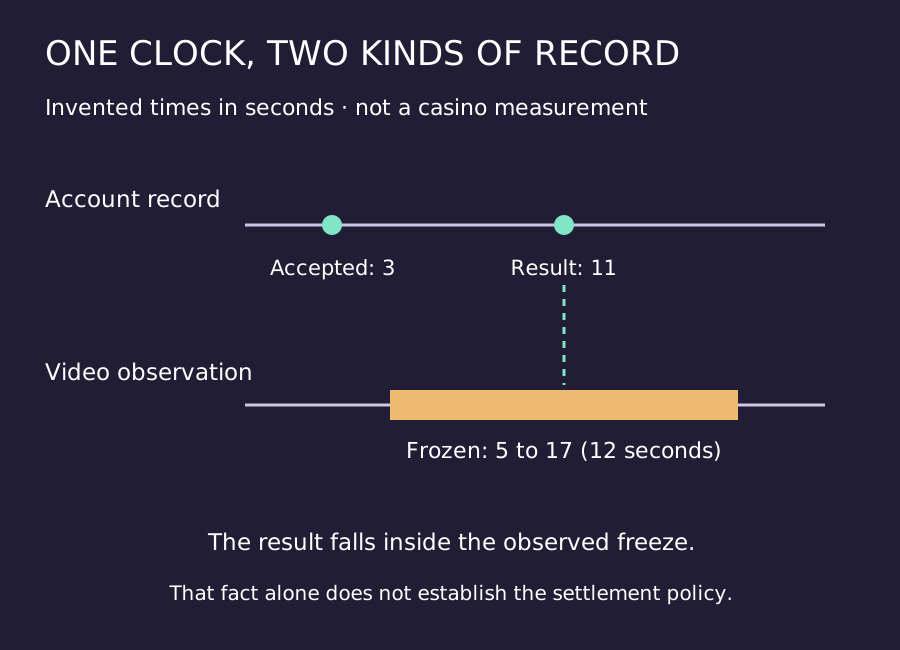
How does a live casino round relate to the stream on your screen?
Follow a live round through acceptance, video, decisions and account records, with an original timeline exercise and a Crazy Time product example.
Read How does a live casino round relate to the stream on your screen?
Continue reading
Best live casino: what happens on the stream, what happens in the round, and the timings the published rules set
The best live casino, by this site’s test, is the one whose operator publishes what happens in the round when the stream fails. Two systems, the standards that govern each, one published decision window, and a stream-delay column marked Not tested until we measure it.
Read Best live casino: what happens on the stream, what happens in the round, and the timings the published rules setWhat a live-dealer studio audit can establish
Distinguish RTS 17 studio coverage from security and games-testing audits. Read a real disclosure response and keep unseen inspection findings unknown.
Read What a live-dealer studio audit can establishThe three layers of a live-table screen
A live-table interface combines a video feed, interactive controls, and an account record.
Read The three layers of a live-table screenInspect a live-table interface
The three layers of a live-table screen
Why is my online casino not working? What happens on the stream, and what happens in the round
What actually happens when your live casino timer runs out
How does a live casino round relate to the stream on your screen?