Core guide
How does a live casino round relate to the stream on your screen?
Follow a live round through acceptance, video, decisions and account records, with an original timeline exercise and a Crazy Time product example.
A live screen combines events that need separate labels
A live casino screen may show a presenter, a betting area, a countdown and an account balance together. The layout makes them feel like a single event, but each element has its own job. A video frame describes what the viewer received. A control describes an available or requested action. A round record describes a transaction or game event.
Our three-layer screen note introduces that separation. The fuller task is to follow one identifiable round across the layers. Start with the exact game, table and round reference where available. Without that connection, a screenshot of a result and a balance change may belong to different moments or even different rounds.
An animation of a chip being selected is not, by itself, the same evidence as an acceptance entry. Similarly, a result visible in a stream is not automatically a statement about the viewer’s own wager. Read the interface labels and the applicable rules to find what each display represents.
This guide uses a deliberately invented timeline to make those distinctions concrete. It also reads Evolution’s Crazy Time description as a real product example. No operator account, video latency or live round has been tested for this guide. The purpose is understanding the evidence a screen can supply, and the additional record needed when the picture becomes incomplete.
That approach works even when the interface looks polished. Clear pictures and clear account information are useful in different ways; neither should be asked to prove something outside its function.
Crazy Time shows why watching and participating differ
Evolution’s Crazy Time page describes a live presenter and money wheel alongside digital game elements. Its explanation distinguishes observing a bonus game from participating after a bet on the corresponding spot. The example is useful because the viewer can see an event without necessarily having the account state that makes them a participant in it.
The practical reading question is therefore not only “What did the wheel show?” It is also “Which round is this, what was accepted and which part of the rules connects that acceptance to this event?” A stream clip usually cannot answer all those questions about an individual account.
Keep the product name exact. A general phrase such as live game show can cover different mechanics, stages and choices. A feature in one named product should not be transferred to another simply because both have a presenter or a large wheel.
For an interface observation, note whether the game explains a later decision before that decision appears. If an instruction is missing from the visible record, describe the missing information rather than infer the default action. The applicable product rules are needed to understand what happens if no choice is received.
The official page is a product explanation, not this publication’s endorsement, a UK availability check or a measurement of a casino’s deployment. We use its narrow viewing-versus-participation distinction here; the page’s promotional language and headline performance figures are not needed to understand the technology question.
Put the interruption on a common clock
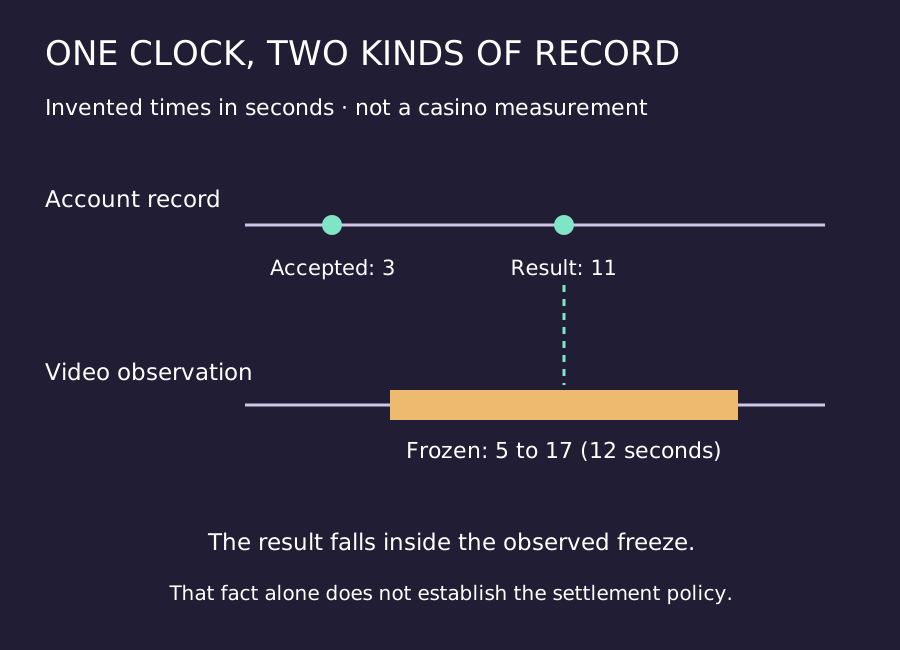
Imagine a single hypothetical clock. An acceptance is recorded at second 3. The viewer sees the video freeze at second 5. A result is recorded at second 11. The video resumes at second 17. The observed freeze lasts 12 seconds, and the recorded result falls within that interval.
Those numbers do not establish that the result was generated by a frozen picture, that the wager disappeared or that a refund is due. They only locate four described events on the assumed common clock. The original diagram keeps the account row and video row separate so that the overlap is visible without turning it into a causal claim.
Real evidence is often less tidy. A phone clock, a website timestamp and a video overlay may use different zones, precision or delay. Before subtracting them, establish whether they refer to the same clock and what the timestamp measures. A time when a message appeared can differ from the event time reported inside the message.
The worksheet uses whole seconds and one clock precisely to remove that ambiguity from the arithmetic exercise. It rejects a result before acceptance and a resume time that is not later than the freeze. Its interval includes the freeze’s start and excludes the resume point, so an event at the exact resume second counts as outside.
Changing the inputs demonstrates the distinction between overlap and explanation. A result outside the freeze also does not prove that every other interface layer worked correctly. The remaining evidence questions do not disappear because the two intervals happen not to cross.
Read interruption treatment at the actual decision point
RTS 10 distinguishes interruption situations rather than giving every disconnection one outcome. Its gaming guidance addresses cases where an accepted gamble has no further customer influence, as well as stateful games where reasonable steps should restore the last known state. The relevant stage of the game matters to the reading.
Our stream-stops note gives the compact reminder to consult the round record. In a fuller reconstruction, identify whether a decision remained, what information the customer had and which rule describes an interruption at that stage. An unresolved multi-stage choice is a different question from a result already determined with no further customer input.
Avoid deciding the policy from the colour of an error banner. “Reconnecting” may describe the client’s communication state, while the underlying round record contains a separate status. If the relationship between them is unclear, keep that inconsistency in the report rather than selecting whichever message appears more favourable.
A concise request to support can identify the round and ask which event was accepted, whether a decision remained, how the published interruption rule was applied and where the corresponding account entry can be found. These questions connect the record to the rule without pretending the customer can see the entire system.
Reopening a page or seeing a later result does not, on its own, explain the earlier sequence. Preserve the original messages if available and label anything reconstructed from memory. That gives the eventual explanation a stable set of observations to address.
Sources: UK Gambling Commission: RTS 10, interrupted gambling.
Four whole-second inputs compare an invented acceptance, result, freeze and resume time.
A countdown is not a network diagnostic
RTS 4 addresses events where interaction speed significantly affects the chance of winning. It requires relevant risk assessment and reasonable risk-reduction steps, with customer information about technical disadvantage for time-critical events. It does not supply one universal acceptable delay for every live casino screen.
A countdown should therefore be read for its stated function. Does it indicate time to submit a selection, time until the next stage or merely a broadcast overlay? A number moving smoothly does not prove that the account action travelled through the system at the same speed.
An invented example illustrates the gap. A viewer sees two seconds remaining and presses a control, but the interface then reports that the action was not accepted. The visible countdown alone does not establish when the system received the request. The response and relevant round records are needed to understand the event.
Do not use repeated real-money submissions as a diagnostic experiment. If the information needed to understand an unresolved round is unavailable, use the documented history and support route. A consumer’s broadband speed result is also not a measurement of every stage between a game control and the operator’s system.
For an observation worksheet, record the exact text and whether the interface distinguishes selection, submission and acceptance. That produces a useful usability finding without claiming access to server logs. It also avoids converting an impression that the game felt slow into a precise latency figure the observation did not measure.
Sources: UK Gambling Commission: RTS 4, time-critical events.
The public camera view and studio audit evidence have different roles
RTS 17 requires covered live dealer operations to be fair and independently auditable. Its guidance discusses trained dealers, supervision, surveillance and game logs. A customer watching a public stream is not automatically viewing the whole surveillance or audit record described by that guidance.
The distinction matters when reading a clip. A camera angle may make one part of a procedure visible and leave another outside the frame. Describe the visible action accurately, including the limits of the view. Do not treat missing footage as evidence that no other record exists, or treat an attractive studio as evidence that every control was independently assessed.
At the end of a reconstruction, keep three short lists: events supported by records, observations limited to the screen and questions still awaiting an answer. This makes it possible to update the account when support supplies a missing round reference or clarifies a status.
The result is a reader’s record of one experience, not a technical audit. Its strength comes from correctly identifying each piece of evidence. A video observation, an accepted-action record and a settlement explanation can support one another when their round, clock and meaning match. When they do not, the mismatch is the next question to resolve rather than a reason to invent the missing connection.
Sources: UK Gambling Commission: RTS 17, live dealer studios.
Questions answered
Does a frozen live casino stream mean the bet is cancelled?
No universal conclusion follows from the picture. The accepted action, remaining decisions, round record and applicable interruption rules are needed.
Is the timeline worksheet a latency test?
No. It compares invented events on one assumed clock and shows interval overlap. It accesses no network or account and determines no refund.
Can a viewer watch a Crazy Time bonus without participating?
Evolution’s official product description distinguishes observing bonus games from participation based on the corresponding accepted bet. Consult the exact game rules for the account-specific situation.