
 READING MONITOR
Core guide
What actually happens when your live casino timer runs out
A decision timer expiring and a connection dropping are governed by different rules with different default actions, even though both can end a round without your input. Here is what each one actually controls, set against the published standards and one operator's own wording.
Two clocks, mistaken for one
A hand goes unplayed and the round settles anyway. A connection drops mid-round and the round settles anyway. From the player's chair these look like the same event: no input was given, and something happened regardless. They are not the same event, and they are not governed by the same rule.
A decision timer is a feature of the game itself. It is set by the game's own rules, it runs whether or not anything is wrong with your connection, and its default action is decided by the studio or provider that built the table. A disconnection is a fault condition. It is governed by interruption policy, it assumes something went wrong somewhere in the chain between your device and the operator's system, and its outcome depends on what stage the round had reached when the fault occurred.
Conflating the two produces two common mistakes. The first is assuming a stood or folded hand after a slow connection means the round was voided because of the fault, when it may simply mean the ordinary timer expired and the ordinary default applied — the same thing that happens to any player who looks away from the screen. The second is assuming a settled result during a frozen picture proves nothing went wrong, when the freeze may have coincided with a genuine interruption that a different policy governs. Separating the two clocks is the first step to reading either one correctly.
What a decision timer actually enforces
UK Gambling Commission standard RTS 4 addresses time-critical events: cases where the speed of a customer's interaction has a significant effect on their chance of winning. It requires operators to assess that risk and to tell customers, in the game description, rules or help pages, that they might be at a technical disadvantage because of factors such as slower network speeds. RTS 13 separately requires elapsed time to be displayed during a gaming session, in a format the player can actually see, rather than being obscured by a full-screen client.
Neither standard sets the specific number of seconds a given table allows for a decision, and neither prescribes what happens when that number runs out. Those specifics sit inside each product's own rules, and they vary. Evolution's Speed Blackjack, for example, is documented by independent reviewers as running a "reduced decision time" of seven seconds per hand, explicitly faster than the provider's standard blackjack tables in exchange for a quicker pace of play. A roulette table works on a different mechanism entirely: rather than a visible countdown, the dealer's verbal call of "no more bets" closes the betting window, as Nevada's regulator documents in its Live Roulette Rules of Play, and no further wager is accepted after that point regardless of how long the spin itself takes.
The practical reading point: a countdown you see on screen is telling you about that specific game's decision window, not about the underlying network, and not about every table running the same product. A seven-second timer on one blackjack variant says nothing about the timer on a different variant from the same or a different provider.
Sources: UK Gambling Commission RTS 4 (Time-critical events); UK Gambling Commission RTS 13 (Time requirements and reality checks); BlackjackInfo: Speed Blackjack by Evolution Gaming; Nevada Gaming Control Board, Live Roulette Rules of Play.
The default when the timer runs out
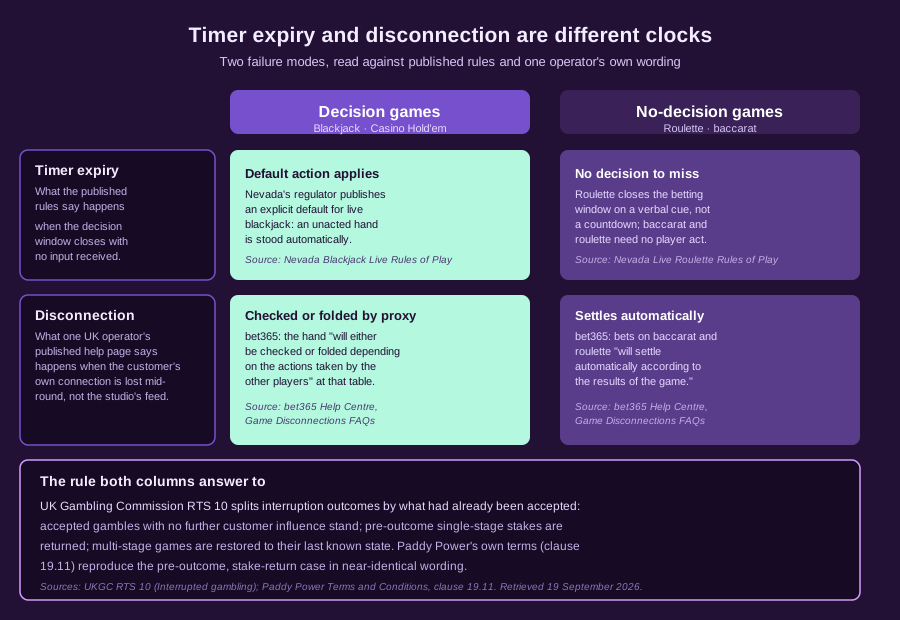
Somebody has to decide what happens to a hand nobody acted on. Nevada's gaming regulator answers this precisely for live blackjack, in language published in its own Rules of Play document: if a player does not make a move, the system applies a stand automatically. That is a regulator stating, in writing, the exact default action for a named game.
Searching for an equivalent statement from a UK source, at the same level of specificity, does not turn up one. The UK Gambling Commission's technical standards address the disclosure obligation — tell the player they might be disadvantaged by timing — rather than mandating a single default action across all live products. That leaves the actual default, for any given UK-facing table, to sit inside that table's own game rules or help documentation, which is not always published with the same precision as a regulator's rules-of-play document. Treat "stand by default" as a documented pattern from one jurisdiction's blackjack rules, not as a guaranteed UK-wide rule for every live product; the honest position is that this specific gap is unverified for the UK market and worth checking against the individual game's own rules before play.
No-decision games sidestep the question by design. Roulette and baccarat outcomes do not depend on a player choice inside the round, so there is no expired decision to default on — only the betting window closing, as covered above.
Sources: Nevada Gaming Control Board, Blackjack Live Rules of Play; UK Gambling Commission RTS 4 (Time-critical events).
Disconnection answers to a different rule
UK Gambling Commission standard RTS 10 governs interrupted gambling directly, and it does not treat every interruption the same way. It sets out three distinct cases. Where an interruption occurs after the operator has already received the customer's gamble, and the customer can have no further influence on the outcome, the result of that gamble stands. Where an interruption to a single-participant, single-stage event happens before an outcome has been generated, any deducted stake should be returned. Where a multi-stage game is interrupted, the operator should take reasonable steps to restore the game to its last known state so the customer can complete it, and progressive jackpot values should be restored to their pre-failure state rather than reset.
The standard also requires operators to be capable of voiding gambles and suspending betting markets when needed, and to publish their interruption policies so customers can find out in advance what will happen in different circumstances. That published-policy requirement is why an operator's own help pages and terms are a legitimate primary source here, not just marketing copy: RTS 10 effectively obliges the policy to exist somewhere public.
Paddy Power's own terms and conditions carry a clause, numbered 19.11 in the version reviewed for this article, stating that where an interruption to a single-participant single-stage event occurs before an outcome has been generated, the stake is returned to the customer's account. That is close to a direct restatement of the RTS 10 pre-outcome case, which is a useful confirmation that the standard's language is making it into actual customer-facing terms rather than staying at the regulatory level.
Sources: UK Gambling Commission RTS 10 (Interrupted gambling); Paddy Power Terms and Conditions, clause 19.11.
How one operator actually applies it
bet365's Game Disconnections help page sets out its own policy in game-specific terms rather than only citing the general principle. For games that involve a player decision, naming blackjack and Casino Hold'em specifically, the published wording says the hand "will either be checked or folded depending on the actions taken by the other players" at that table. For games with no player decision to make once bets are placed, naming baccarat and roulette specifically, the bets "will settle automatically according to the results of the game."
Read against RTS 10, this is one operator's practical translation of "no further customer influence" into per-game language: a decision game gets resolved by proxy through what the table as a whole did, while a no-decision game simply runs its outcome. bet365's page also tells customers how to recover from the fault on their end — log out and back in, restart the browser or app, clear cache and cookies, try a different connection — and states that reconnection to an in-progress session happens automatically once the customer's connection is restored. It also points customers to their own game history to check what was recorded, rather than asking them to judge the outcome from the last frame they saw.
This is one operator's stated policy, current as retrieved for this article. It is not evidence about how any other operator, provider or specific table applies the same underlying standard, and operator help pages can and do change without a corresponding change to the regulation beneath them.
Sources: bet365 Help Centre, Game Disconnections FAQs; UK Gambling Commission RTS 10 (Interrupted gambling).
Where the two rules overlap, and where they diverge
The overlap is the default action itself. Whether a blackjack hand goes unplayed because the visible timer ran out, or because the player's connection dropped for those same few seconds, the practical resolution converges on the same mechanism described above: something else — an automatic stand, or the state of the other seats — determines what the hand does. From the round record alone, a player may not always be able to tell which cause produced that outcome.
The divergence is everything that happens around the resolution. A timer expiring while the connection is intact is an ordinary, expected event built into the game; it generates no support ticket, no reconnection flow and, per RTS 4, should have already been disclosed as a normal feature of that table's pace. A disconnection is a fault; it is what triggers the recovery steps on an operator's help page, it is what the RTS 10 policy language is actually written to cover, and it is the scenario where checking the round record and, if needed, contacting support with the round reference is the appropriate response rather than assuming a routine timeout occurred.
The four combinations, and the rule or document that governs each, are set out below.
| Scenario | What happens to the bet | What happens to the hand or round | Governing rule or document | Source |
|---|---|---|---|---|
| Decision game (blackjack, Casino Hold’em) — decision timer expires | Stays in play; the round settles on the hand as defaulted. | The game’s own default action applies. Nevada’s regulator states that a hand the player does not act on is stood on automatically. No UK-published default of the same precision was found for this article. | The individual game’s own rules; RTS 4 requires the timing disadvantage to be disclosed, but sets no default action. | Nevada Gaming Control Board, Blackjack Live Rules of Play; UK Gambling Commission RTS 4. |
| Decision game (blackjack, Casino Hold’em) — connection drops | An accepted gamble the customer can no longer influence stands as recorded. | bet365’s published wording: the hand “will either be checked or folded depending on the actions taken by the other players” at that table. | UK Gambling Commission RTS 10, interrupted gambling; the operator’s own published interruption policy. | bet365 Help Centre, Game Disconnections FAQs; UK Gambling Commission RTS 10. |
| No-decision game (roulette, baccarat) — betting window closes | Bets placed before the window closes stand; no further wager is accepted after it. | There is no player decision inside the round, so there is no expired decision to default on — only the dealer’s call of “no more bets” closing the betting window. | The table’s own rules of play; RTS 4 disclosure applies as above. | Nevada Gaming Control Board, Live Roulette Rules of Play; UK Gambling Commission RTS 4. |
| No-decision game (roulette, baccarat) — connection drops | Stands where the outcome has already been generated; where a single-participant, single-stage event is interrupted before an outcome is generated, the deducted stake is returned. | bet365’s published wording: the bets “will settle automatically according to the results of the game.” | UK Gambling Commission RTS 10, interrupted gambling; Paddy Power Terms and Conditions, clause 19.11, restating the pre-outcome case. | bet365 Help Centre, Game Disconnections FAQs; UK Gambling Commission RTS 10; Paddy Power Terms and Conditions, clause 19.11. |
The practical rule for a player trying to work out which happened: if the interface itself reported a connection problem — an error banner, a reconnecting message, a dropped video feed — treat it as the disconnection case and follow the interruption policy. If the interface behaved normally throughout and a decision simply passed without being made, treat it as an ordinary timer default, and check that specific game's own rules for what that default is.
Reading your own operator's clause
Every UK-facing operator offering relevant live gambling is expected, under RTS 10, to publish an interruption policy somewhere a customer can find it before it becomes urgent. Locating it before an issue happens, rather than searching for it mid-dispute, is the useful habit this article is trying to encourage.
Three things are worth checking for in that published clause. First, whether it distinguishes decision games from no-decision games the way bet365's page does, or states one policy for all live products, since that changes what you should expect from a blackjack table versus a roulette table. Second, whether it references restoring a multi-stage game to its last known state, which matters for products with genuine multi-round structures such as bonus wheels or multiplier stages, rather than only for straightforward single-outcome bets. Third, whether it tells you what to do next: which support channel to use, what information to have ready such as the round reference and approximate time, and how to view your own game history.
A clause that answers all three, in specific rather than generic language, is doing what RTS 10 asks of it. A clause that only restates "interruptions will be handled fairly" without naming a mechanism is technically compliant with very little, and is worth reading alongside the regulator's own text rather than taking at face value.
Sources: UK Gambling Commission RTS 10 (Interrupted gambling).
What this reference cannot tell you
This page compares published rules and one operator's published wording. It does not measure real network latency for any product, it does not test a live table under an engineered disconnection, and it does not confirm that any operator's practice matches its own published policy in every case — that would require an audit, which is exactly the kind of evidence RTS 17 places behind the camera rather than in the public stream. Nevada's blackjack default is documented for that jurisdiction's regulated tables; it is used here because it is the clearest published example of a regulator stating a specific default action, not as proof that UK operators run an identical default. Where UK-specific documentation of that precision does not appear to exist publicly, that gap is stated as a gap, not filled in with an assumption.
The seven-second figure for Speed Blackjack is a single documented data point for one named product; other blackjack variants, from the same or other providers, are not assumed to share it. If a specific decision timer or disconnection outcome matters to you on a specific table, the table's own rules page and the operator's own published policy are the primary sources, checked at the time you are playing, not this article.
Source material
- UK Gambling Commission: RTS 10, interrupted gambling — retrieved 19 September 2026
- UK Gambling Commission: RTS 4, time-critical events — retrieved 19 September 2026
- UK Gambling Commission: RTS 13, time requirements and reality checks — retrieved 19 September 2026
- UK Gambling Commission: RTS 17, live dealer studios — retrieved 19 September 2026
- bet365 Help Centre: Game Disconnections FAQs — retrieved 19 September 2026
- Nevada Gaming Control Board: Blackjack Live Rules of Play — retrieved 19 September 2026
- Nevada Gaming Control Board: Live Roulette Rules of Play — retrieved 19 September 2026
- BlackjackInfo: Speed Blackjack by Evolution Gaming — retrieved 19 September 2026
- Paddy Power: Terms and Conditions — retrieved 19 September 2026